
The Effects of NeuroGraphic Art on Your Brain
Updated: Jul 13

Draw a line. Any line. How straight is it? What direction does it go?
Draw another. This time, lead the line where it feels uncomfortable. What does that look like? Are you prone to rigid shapes? Do you fear symmetry, or being unable to achieve symmetry?
Observe what these lines tell you about yourself. How might they model real-life conflict? What would it look like to resolve the tension in these lines like the tension in your life?
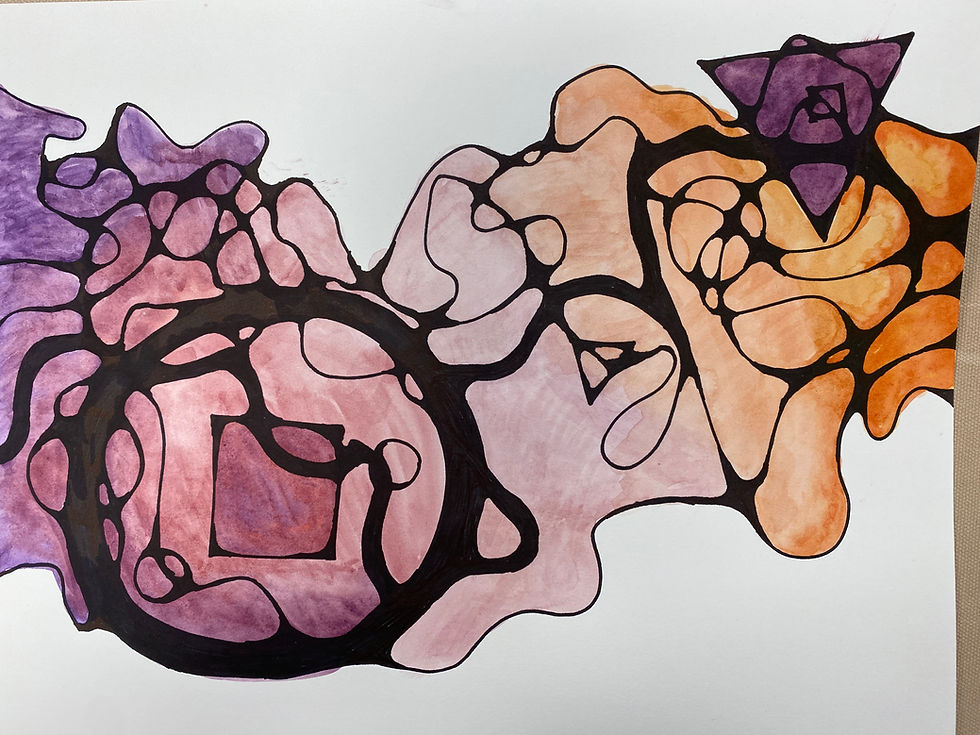
If you can draw it, then you can see it, know it and begin to understand it. This way of drawing is known as NeuroGraphics, which was developed with the idea that every problem has a graphic solution. Plainly, NeuroGraphics is a method of processing mental and creative blocks in intuitive, visually-pleasing shapes and lines. Beyond doodling, it is a conscious practice of guiding the hand, using structured techniques to draw, feel, and observe cognitive changes.

Some Background
Credit where credit is due, we did not invent this way of drawing. The technique was created by architect and psychologist Pavel Piskarev, Ph.D. Based in neuropsychology — the science of how experience changes the brain — the idea is that drawing activates sensory, motor and emotional thinking. New neural pathways are formed by linking emotions and repetition to allow your brain to adopt positive associations with change.
How Can I Use NeuroGraphic?
Conflict Resolution and Problem Solving
What has been a source of tension in your life? Maybe you are trying to tackle a difficult assignment at work. Maybe you and a friend got into a fight. Maybe your roommate keeps eating your romaine lettuce from the fridge without asking, despite repeated conversations about it.
Whether it’s relationships, work, home, or life, NeuroGraphics is designed to help you approach and overcome it. You can draw the dynamic, visualize repeated patterns in conflict, and change how you process it from reactive to regulated.

Creative Blocks
Artist’s block will come for us all. Sometimes a blank page or an unformed ball of clay is the most terrifying thing in the world.
Not only is NeuroGraphic art a great way to get the pencil moving, it is also a structured way to plan creative projects. Is there a specific emotion you want to represent in your work? Is there movement or motion you want to capture? What do you want your audience or an observer to feel when they look at your work? The repetition and intention of neural lines allow your brain to hone in and refine what you want your creative works to represent, evoke, or look like.

Goal Modelling
A common way to set goals is to break them down into their smallest components so they feel less daunting. Just identify the first step. Seems simple enough.
But what if you have absolutely no idea what that first step is or how to decide what path is right for you from the several paths to get there or how to know what your goal actually is from all the things you want to do?
Take a breath, pick up the pen, draw it out. With NeuroGraphics, you can test pathways for growth and change in a contained and structured way. You can observe the path take form, guided by recognized emotions and active cognition.

Mindfulness and Routine
In our digital, fast-paced world, it seems that stress and noise is with us everywhere we go… because it is. In the form of your phone. There are Teams messages after hours, that weird guy from Hinge with your personal number, your roommate that says they won’t be coming to the roommate meeting that was specifically called because of their lettuce issue.
Life feels complex because it is. NeuroGraphics is a way to cope and process the complexity, cognitive load and inner noise of every day. It is a technique that will ground you in the present, end cyclical thought by engaging your attention in a way thinking cannot, and be something (besides your phone) that you can take with you everywhere you go.

Why We Love It (And You Will Too)
Sometimes it’s easy to get lost in routine. Even as a studio of artists, we can find ourselves treading and re-treading the same creative ground. What new projects do we want to make? How can we tweak an existing class to better the student’s experience? How might we continue to value and check in on our mental and emotional health?
We ran a test class with the staff to practice engaging with the technique and see the results for ourselves. We identified what felt tense or uncomfortable in the lines, we felt more connected to the regulated versions of ourselves, and we got completely lost in the exercise, losing track of time and the social media content we had to film (oops!).
Basically, we tried it. It works. We love it and you will too.
Are you interested in learning how to make NeuroGraphic art of your own? Join us for a workshop designed for disentangling conflict, goal-setting and creativity from your artistic and conscious mind.
Signed,
Your Local Eccentric Artist


